Buying commercial property in Georgia requires more than confirming the price and signing a purchase agreement. A serious legal due diligence review examines whether the seller can transfer the property, whether the property can be used for your intended purpose, whether leases and other obligations will follow you after closing, and whether the contract gives you enough protection if a problem is discovered.
Commercial real estate can involve title records, zoning and land-use rules, surveys, environmental concerns, leases, financing, entity ownership, tax and assessment issues, and negotiated contract protections. The right review depends on the property and the buyer’s plans, so due diligence should be tailored to the transaction rather than treated as a one-size-fits-all checklist.
This guide explains the legal due diligence issues Georgia buyers should consider before purchasing commercial property and shows where an attorney can help identify problems while there is still time to negotiate a solution.
Key Takeaways
- Title review helps identify ownership problems, liens, easements, restrictions, and other matters that may affect the buyer’s interest.
- Zoning due diligence should confirm that the property’s current and intended uses are legally permitted—or identify approvals that must be obtained.
- A current survey can reveal boundaries, encroachments, easements, access issues, and physical conditions that a title search alone may not show.
- Environmental review is especially important for commercial and industrial property because contamination can create substantial investigation and cleanup exposure.
- Existing leases can transfer significant landlord obligations to a buyer, making lease files, amendments, estoppels, and tenant issues part of the legal review.
- The purchase agreement should give the buyer enough time and contractual rights to investigate the property and respond to unacceptable findings.
- Ownership structure should be addressed before closing when an LLC or other entity is intended to hold title, particularly when financing is involved.
- The goal of due diligence is not to eliminate every risk. It is to identify material risks early enough to price them, cure them, allocate them, or walk away when the contract allows.
Legal due diligence for a Georgia commercial property purchase is the process of investigating title, land use, contracts, leases, environmental and physical issues, ownership, and other legal risks before closing. A thorough review gives the buyer information needed to decide whether to proceed, renegotiate, require a cure, or exercise contractual rights.
What Is Legal Due Diligence When Buying Commercial Property in Georgia?
Legal due diligence is the investigation of the property’s legal condition and the transaction’s risk allocation before the buyer becomes fully committed to closing. It is broader than a title search and broader than a property inspection. The attorney’s role is to connect the documents and facts to the buyer’s actual deal.
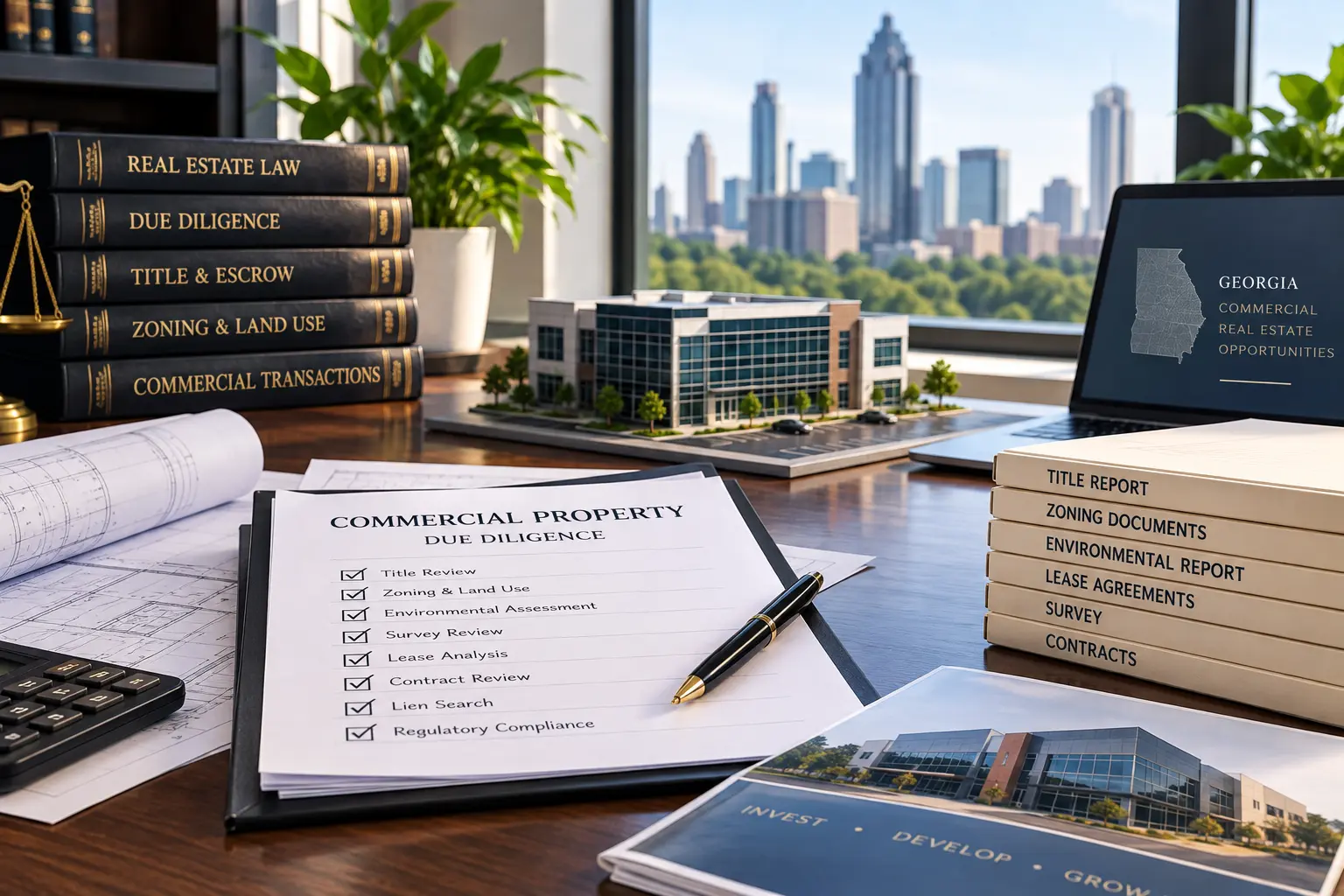
Depending on the transaction, the review may include:
- Title examination and review of the title commitment
- Liens, judgements, easements, restrictions, and other encumbrances
- Survey and boundary issues
- Zoning, permitted use, and land-use restrictions
- Leases, amendments, tenant obligations, and estoppel certificates
- Environmental reports and contamination concerns
- Purchase agreement terms, contingencies, representations, and remedies
- Seller and entity authority
- Financing conditions and lender requirements
- Tax, assessment, permit, code, and governmental issues
- Ownership structure and title-vesting decisions
- Closing conditions and post-closing obligations
The exact scope should follow the asset. A single-tenant retail property, an apartment building, an industrial site, an office building, and undeveloped land can each present very different legal risks.
How Do You Verify Clear Title on a Georgia Commercial Property?
Title examination is one of the first places an attorney looks for problems that could interfere with the buyer’s ownership or financing. The review generally examines the recorded chain of title and the matters disclosed by the title search and commitment.
A commercial title review may address:
- The chain of title and whether the seller has the authority to convey the property
- Existing mortgages and other liens that must be paid or released
- Property-tax claims or other governmental liens
- Judgement liens and other claims against the seller that may affect the transaction
- Recorded easements and rights-of-way
- Restrictive covenants and declarations
- Prior deeds or instruments that create questions about the legal description or ownership
- Pending litigation, foreclosure, bankruptcy, probate, or entity-authority issues when relevant
- Exceptions that the buyer needs the title company to remove, insure over, or otherwise address
Georgia’s recording system provides public notice through recorded instruments, but title analysis still requires more than simply finding the latest deed. The attorney needs to understand how the recorded documents fit together and whether known or discovered matters affect the buyer’s intended ownership and use.
For public-record research, buyers and counsel can use the Georgia Superior Court Clerks’ Cooperative Authority as a starting point for Georgia real estate records. A public-record search is not a substitute for professional title examination.
What Should You Look for in a Commercial Title Commitment?
The title commitment is not just a document to file away before closing. It identifies the proposed coverage and lists exceptions and requirements that can affect the buyer’s risk.
- Confirm the named owner matches the party selling the property.
- Review Schedule B exceptions instead of assuming every item is harmless.
- Identify monetary liens and confirm how they will be released or paid at closing.
- Check easements, covenants, access rights, and other restrictions against the buyer’s intended use.
- Compare the legal description with the purchase agreement and survey.
- Discuss needed endorsements with the title company and determine which exceptions the buyer will accept.
- Make sure agreed title objections are addressed before the contractual objection deadline.
What Zoning and Land-Use Issues Should Georgia Commercial Buyers Investigate?
A property can be physically suitable for a business and still be legally unsuitable for the buyer’s intended use. Zoning and land-use review should therefore begin with a simple question: Can you legally operate the business, development, or use you are planning at this property?
- Current zoning classification
- Permitted uses and whether the intended use is allowed as of right
- Conditional-use, special-use, variance, or rezoning requirements
- Nonconforming or grandfathered uses and the rules governing their continuation or expansion
- Parking, loading, access, and site-plan requirements
- Setbacks, building height, lot coverage, signage, and other development controls
- Pending zoning changes, moratoriums, or development restrictions
- Certificates of occupancy, permits, and known code violations when relevant
Do not rely solely on a broker, seller, or informal statement about whether a proposed use is allowed. For a material acquisition, obtain written information from the appropriate local authority and have counsel assess how the zoning rules interact with the purchase contract and the buyer’s plans.
Why Are Environmental Assessments Important for Commercial Property Due Diligence?
Environmental risk can be particularly important for commercial and industrial property because the property’s history may involve manufacturing, fuel storage, dry cleaning, waste handling, industrial operations, or other activities that create contamination concerns.
A Phase I Environmental Site Assessment is a common starting point for identifying potential environmental conditions. It typically reviews historical uses, current conditions, neighboring properties, regulatory information, and other indicators of potential contamination.
Depending on the findings, the due diligence process may require review of:
- Historical property uses and prior tenants
- Underground storage tanks or other potential sources of contamination
- Regulatory database listings
- Recognized environmental conditions identified in the Phase I
- Prior environmental reports and remediation records
- Soil or groundwater testing when additional investigation is warranted
- Environmental permits, notices, or agency correspondence
- Contract provisions allocating cleanup, indemnity, and remediation responsibilities
The U.S. Environmental Protection Agency’s Superfund resources provide background on federal cleanup and liability programs. Environmental liability is highly fact-specific, so buyers should have qualified environmental professionals and counsel evaluate identified conditions.
What Should a Commercial Property Survey Reveal?
A survey translates the property’s legal description into a physical picture of the land. For a commercial acquisition, the survey can reveal problems that are difficult to spot from title records alone.
- Boundary lines and property corners
- Building locations and apparent encroachments
- Recorded easements and rights-of-way
- Access points and apparent access issues
- Parking and other site improvements
- Setback or development concerns
- Flood-zone information when included or otherwise required
- Improvements or physical conditions that do not align with the legal description
For commercial transactions, the buyer, lender, and title company may require an ALTA/NSPS Land Title Survey. The 2026 standards took effect February 23, 2026, so the survey requirements should be confirmed for the transaction rather than assumed from an older checklist.
If a survey identifies an encroachment, access problem, or other objection, the attorney can help determine whether it should be cured, insured over, documented by agreement, addressed through a purchase-price adjustment, or treated as a reason not to proceed.
How Do Existing Leases Affect a Commercial Property Purchase?
If you are buying an occupied commercial property, the leases can be as important as the building itself. The buyer may acquire the landlord’s rights and obligations along with the property, subject to the transaction documents and applicable law.
Review the complete lease file for:
- Base rent, escalations, options, and remaining term
- Security deposits and prepaid rent
- Tenant improvement obligations and allowances
- Maintenance, repair, insurance, and tax responsibilities
- Assignment and subletting rights
- Exclusive-use and prohibited-use provisions
- Renewal, termination, kick-out, or early-exit rights
- Default notices, disputes, concessions, and side agreements
- Options or rights that could affect future leasing or redevelopment
Ask for executed leases, amendments, guaranties, correspondence concerning disputes, and current tenant estoppel certificates where appropriate. An estoppel can help confirm what the tenant believes the lease says and whether there are known defaults, credits, concessions, or other arrangements that are not obvious from the lease itself.
For a property whose value depends heavily on rental income, lease review should also be paired with a practical assessment of tenant concentration, remaining lease terms, renewal exposure, and other factors that could affect the investment.
What Contract Protections Should Georgia Commercial Buyers Negotiate?
The purchase agreement is the legal framework for the entire due diligence process. A buyer can investigate the property thoroughly and still be exposed if the contract does not give the buyer enough time, access, termination rights, or remedies to act on what the investigation reveals.
| Contract Protection | What It Should Address | Why It Matters |
| Due diligence period | Investigation deadlines; access to records and property | Gives the buyer time to investigate before key rights expire. |
| Title and survey rights | Objection procedures, cure obligations, acceptable exceptions, survey standards | Defines what happens when title or survey problems are discovered. |
| Zoning/use contingency | Required approvals or confirmation of intended use | Prevents the buyer from being locked into a property that cannot serve the planned purpose. |
| Environmental protections | Reports, testing, representations, indemnities, and risk allocation | Addresses potentially expensive contamination or cleanup issues. |
| Seller representations | Condition, leases, litigation, compliance, authority, and other material facts | Creates contractual remedies if agreed representations prove inaccurate. |
| Closing conditions | Documents, estoppels, releases, approvals, payoff statements, and other deliverables | Makes clear what must be completed before funds and title are exchanged. |
| Default remedies | Termination, deposit treatment, specific performance, damages, and other remedies | Provides a roadmap if a party fails to perform. |
| Post-closing obligations | Record corrections, transition matters, cooperation, or surviving representations | Addresses issues that appropriately continue after closing. |
Commercial contracts are often heavily negotiated. The right language depends on the transaction, but the central principle is consistent: the contract should give the buyer meaningful rights to investigate and respond to material problems before the buyer is obligated to close.
What Seller and Entity Issues Should You Verify?
The buyer should also confirm that the party signing the purchase agreement actually has authority to sell the property. This becomes especially important when the seller is an LLC, corporation, partnership, trust, estate, or other entity.
- Confirm the record owner and contracting seller are the same party or are properly connected.
- Review organizational documents and authority where needed.
- Confirm required member, manager, director, partner, trustee, or other approvals.
- Identify probate, divorce, bankruptcy, receivership, or other circumstances that may affect authority when applicable.
- Verify payoff and release arrangements for existing loans and liens.
- Make sure the deed and closing documents use the correct legal names and vesting language.
If a buyer needs an entity to hold title, that decision should be made before closing. The Georgia Secretary of State’s LLC registration guidance explains the state registration process. The appropriate ownership structure, however, depends on the buyer’s tax, financing, liability, governance, and investment objectives and should be evaluated with legal and tax advisers.
What About 1031 Exchanges When Buying Commercial Property?
If the acquisition is part of a Section 1031 exchange, the buyer should raise that issue early rather than treating it as a closing-day detail. The transaction structure, identification and replacement-property requirements, ownership considerations, and intermediary arrangements can affect how the purchase is documented.
A 1031 exchange is a tax-driven transaction with rules outside the scope of a general real estate due diligence checklist. Coordinate with qualified tax counsel and the qualified intermediary early so the purchase agreement and closing process do not accidentally undermine the planned exchange.
What Red Flags Should Stop or Slow a Commercial Property Closing?
Not every red flag means the buyer should walk away. Some problems are curable; others can be priced, insured, documented, or allocated by contract. The important point is to identify them before the buyer loses the contractual ability to respond.
- Unreleased liens or unresolved title defects
- An easement or restriction that conflicts with the intended use
- A survey showing an encroachment or uncertain access
- Zoning that does not permit the planned business or redevelopment
- Material environmental concerns without a clear remediation or risk-allocation plan
- Lease obligations or tenant disputes that materially change the expected economics
- Missing permits, code issues, or unclear certificates of occupancy
- Seller representations that conflict with diligence findings
- An entity or ownership problem that prevents clean authority to sell
- Contract deadlines that are approaching before critical diligence is complete
A strong due diligence process does not mean finding zero problems. It means finding the important problems early enough to decide what to do about them while the purchase agreement still gives the buyer leverage.
How Does Jaraysi Law Group Support Commercial Property Buyers in Georgia?
Jaraysi Law Group focuses on the intersection of real estate, business, and commercial law. The firm’s current practice materials describe support for investors, businesses, developers, property owners, lenders, builders, and other clients involved in commercial transactions.
Its commercial real estate transaction services can include:
- Title review and title issues
- Purchase and sale agreements
- Due diligence analysis
- Commercial real estate transactions
- Development and builder representation
- Investor representation
- Easements, access, and property rights
- Closing and transaction support
- Business formation and ownership structuring
- Landlord-tenant and leasing matters
The firm’s broader business-law practice can also matter when the property acquisition is tied to a new entity, operating business, investment structure, development project, or ongoing commercial relationship. That integrated approach can help keep the real estate documents aligned with the client’s broader business objectives.
Protect Your Commercial Property Investment Before Closing
Commercial property due diligence is where buyers get the opportunity to learn what they are actually acquiring before the transaction becomes much harder to change. A title defect, zoning restriction, lease obligation, environmental issue, or contract gap is far easier to address before closing than after ownership has transferred.
If you’re considering buying commercial property in Georgia, schedule a consultation with Jaraysi Law Group to discuss the transaction, the property’s risks, and the legal due diligence that may be appropriate for your deal.
FAQs
What is legal due diligence when buying commercial property in Georgia?
Legal due diligence is the process of investigating the property’s title, land use, contracts, leases, environmental issues, ownership, and other legal risks before closing. The scope should be tailored to the property and the buyer’s intended use.
How long does commercial real estate due diligence take in Georgia?
There is no single legally required due diligence period for every commercial purchase. The timeline is primarily contractual and depends on the property’s complexity, the documents available, financing, surveys, environmental work, zoning questions, and other investigations. The buyer should negotiate enough time to complete material diligence before key rights expire.
What should a Georgia commercial property title search reveal?
It should help identify the ownership history and recorded matters that may affect the property, including liens, easements, restrictions, judgments, mortgages, and other title exceptions. The title commitment should then be reviewed carefully to determine which matters need to be cured, insured, or accepted.
Do I need an ALTA/NSPS survey to buy commercial property in Georgia?
Not every transaction has the same survey requirement, but commercial buyers and lenders commonly use ALTA/NSPS Land Title Surveys because they provide detailed information about boundaries, easements, encroachments, access, and other matters relevant to title and financing. The purchase contract should specify the survey standard appropriate for the deal.
Why is zoning due diligence important before buying commercial property?
Zoning determines whether the buyer can legally use the property for the intended business or development. A property may have a current use that is nonconforming or may require a conditional approval, variance, or rezoning for the buyer’s plans.
Should I review existing leases before buying an occupied commercial property?
Yes. Existing leases can affect rental income, landlord obligations, repairs, renewals, tenant improvements, exclusivity, termination rights, and future use of the property. Buyers should review complete lease files and obtain current estoppel certificates when appropriate.
Can environmental contamination become the buyer’s problem after closing?
Potentially. Environmental liability is highly fact-specific and can involve federal and state laws, property history, contractual allocations, and available defenses. Buyers should investigate environmental conditions before closing and address material risks in the purchase agreement.
Should I form an LLC before buying commercial property in Georgia?
If an LLC or other entity is intended to own the property, the ownership structure should generally be addressed before closing so the deed, financing, organizational documents, and tax planning are aligned. The right structure depends on the buyer’s circumstances and should be evaluated with legal and tax advisers.
What happens if due diligence uncovers a serious problem?
The answer depends on the purchase agreement. Possible responses include requiring a seller cure, negotiating a credit or price adjustment, obtaining an endorsement or other protection, extending a deadline, amending the agreement, or exercising a contractual termination right.
When should I hire a commercial real estate attorney in Georgia?
Ideally, before or shortly after signing the purchase agreement. Early involvement gives counsel more opportunity to negotiate due diligence rights, review the contract, identify title and land-use issues, coordinate investigations, and address problems before closing deadlines become urgent.
This article is for general informational purposes and is not a substitute for legal advice about a specific commercial real estate transaction.
Disclaimer: This article is provided by Jaraysi Law Group LLC for general informational purposes only and does not constitute legal advice. Reading this content does not create an attorney-client relationship. Laws, fees, regulations, and court decisions referenced may change. For advice on your specific situation, please contact Jaraysi Law Group LLC directly to schedule a consultation.