A closing is more than a meeting where a buyer and seller sign paperwork. By the time the parties reach the closing table, important legal and financial decisions have already been made. Problems involving title, contract terms, property condition, surveys, financing, ownership entities, or required documents can still threaten the transaction if they are not addressed early.
Georgia is also different from many states because real estate closings are conducted under the supervision and control of a Georgia-licensed attorney. That makes the attorney’s role more than administrative: the closing lawyer must review the transaction documents, address errors and title issues, and control the legal closing process.
For buyers, sellers, investors, lenders, and developers, understanding what the attorney does before closing can make it easier to spot delays early, understand what documents matter, and know when a legal issue needs to be resolved rather than pushed to closing day.
Key Takeaways
- Georgia is an attorney-closing state, so a Georgia-licensed attorney must control the legal closing process.
- Title examination can uncover liens, easements, ownership issues, restrictions, and other matters that may need to be resolved before closing.
- The attorney reviews the purchase agreement and related documents to make sure the transaction terms can actually be carried through at closing.
- Surveys, inspections, zoning information, leases, HOA documents, tax information, and other due diligence materials may affect whether the property is ready to close.
- Closing documents must match the contract, title information, lender requirements, and the parties’ legal names and authority.
- When a problem appears, the attorney may help negotiate a cure, amendment, credit, escrow arrangement, extension, or—when appropriate—termination of the transaction.
Why Is an Attorney Involved Before a Georgia Real Estate Closing?
Georgia treats the legal supervision of a real estate closing as the practice of law. The Georgia State Bar’s published guidance states that a closing lawyer must review the documents used in the transaction, resolve paperwork errors, detect and address title ambiguities or defects, and control the closing process from beginning to end. See the State Bar of Georgia’s 2025 Formal Advisory Opinion No. 23-1 for the current guidance on attorney control of the closing process, including remote participation.
That role matters because the attorney is dealing with the legal condition of the transaction—not simply checking whether everyone has signed the right number of pages. The goal is to identify issues while there is still time to solve them.
Depending on the transaction, pre-closing legal work may involve:
- Reviewing the purchase and sale agreement and amendments
- Examining title and identifying liens, easements, restrictions, or ownership problems
- Comparing the legal description with survey and property information
- Reviewing lender requirements and loan documents
- Checking entity authority when a company, partnership, trust, or other entity is buying or selling
- Reviewing due diligence materials that affect the property’s use or value
- Preparing or reviewing deeds, affidavits, settlement documents, and other closing paperwork
- Coordinating the resolution of issues that could prevent closing or create problems after closing
A Georgia real estate attorney’s pre-closing job is to identify legal and transaction risks early, make sure the documents and title support the deal, coordinate the parties needed to close, and resolve or properly document issues before ownership changes hands.
What Does a Real Estate Attorney Check Before Closing?
The exact checklist depends on the transaction. A straightforward residential purchase may require a different review from a commercial acquisition involving tenants, financing, zoning, multiple owners, or an LLC. The attorney’s review should therefore follow the actual deal rather than rely only on a generic closing checklist.
| Area of Review | What the Attorney Looks For | Why It Matters |
| Title | Ownership, liens, easements, restrictions, prior deeds, judgments, and other encumbrances | The buyer needs a legally transferable interest with known title issues addressed. |
| Contract | Purchase price, contingencies, deadlines, credits, prorations, default rights, and amendments | The closing documents and settlement need to match the deal the parties actually made. |
| Survey | Boundaries, encroachments, easements, access, and improvements | A title search may not reveal every physical condition affecting the property. |
| Due diligence | Zoning, permits, leases, HOA materials, taxes, environmental information, and property-use issues | A legal defect or restriction can affect value, financing, or intended use. |
| Financing | Lender instructions, loan documents, required conditions, and closing figures | A mismatch between the contract, loan, and closing package can delay funding. |
| Closing documents | Deed, affidavits, settlement documents, entity authority, and other required instruments | Errors can create recording, title, ownership, or post-closing problems. |
How Does Title Examination Work?
Title examination is one of the most important parts of the pre-closing process. The attorney reviews the property’s recorded history and the title information provided for the transaction to determine who owns the property and what claims, restrictions, or interests may affect it.
Depending on the property and transaction, the review may address:
- The chain of title and whether the seller has the authority to convey the property
- Outstanding mortgages, tax liens, judgment liens, or other recorded claims
- Easements affecting access, utilities, drainage, or neighboring property rights
- Restrictive covenants, declarations, or other recorded limitations
- Legal descriptions and whether they are consistent across the relevant documents
- Prior deeds or other instruments that create questions about ownership
- Issues that must be resolved before the title company can remove an exception or issue the desired coverage
A title problem does not automatically mean a transaction has to fail. The appropriate solution depends on the defect. It may involve obtaining a release, paying an outstanding lien, correcting a document, obtaining an affidavit, negotiating an amendment, or addressing the issue through title insurance or another agreed solution.
The important point is timing: discovering a title problem a week before closing is very different from discovering it after the buyer has already taken ownership. Early review gives the parties more options.
What Contract Issues Are Reviewed Before Closing?
The purchase agreement controls the business terms of the transaction, but the closing attorney must turn those terms into a legally workable closing. That means reviewing the contract and every amendment for provisions that affect what must happen before funds can be disbursed and title can be transferred.
Inspection and due diligence deadlines: The attorney checks whether contractual deadlines, repair rights, termination rights, and negotiated extensions are properly documented.
Financing conditions: The transaction may need amendments or additional documentation if the lender’s requirements change or financing is delayed.
Seller obligations: The attorney may need evidence that agreed repairs, releases, documents, or other seller obligations have been completed.
Credits and prorations: Taxes, rents, HOA charges, utilities, repair credits, and other adjustments need to be reflected correctly in the settlement.
Default and termination rights: If a problem prevents closing, the parties need to understand the contract’s remedies, extension provisions, and earnest-money consequences.
For commercial transactions, the review can be considerably broader. Purchase agreements may address leases, tenant estoppels, operating requirements, development rights, environmental matters, assignment of contracts, seller financing, indemnities, representations, and other provisions that need to survive or be satisfied at closing.
How Does a Survey Affect the Closing?
A survey provides information that cannot always be confirmed through a title search alone. An attorney can compare the survey with the legal description and recorded documents to identify issues that could affect ownership, access, financing, development, or intended use.
- Boundary lines and monuments
- Recorded and apparent easements
- Encroachments involving buildings, fences, driveways, or other improvements
- Access and ingress/egress concerns
- Flood-zone information when relevant to the transaction
- Setback or other land-use concerns that warrant further investigation
If the survey reveals an encroachment or access problem, the answer is not necessarily to cancel the transaction. Depending on the facts, the parties may be able to obtain an agreement, easement, boundary resolution, seller credit, title endorsement, or other remedy. The key is identifying the issue while the parties still have leverage to address it.
What Other Due Diligence Happens Before Closing?
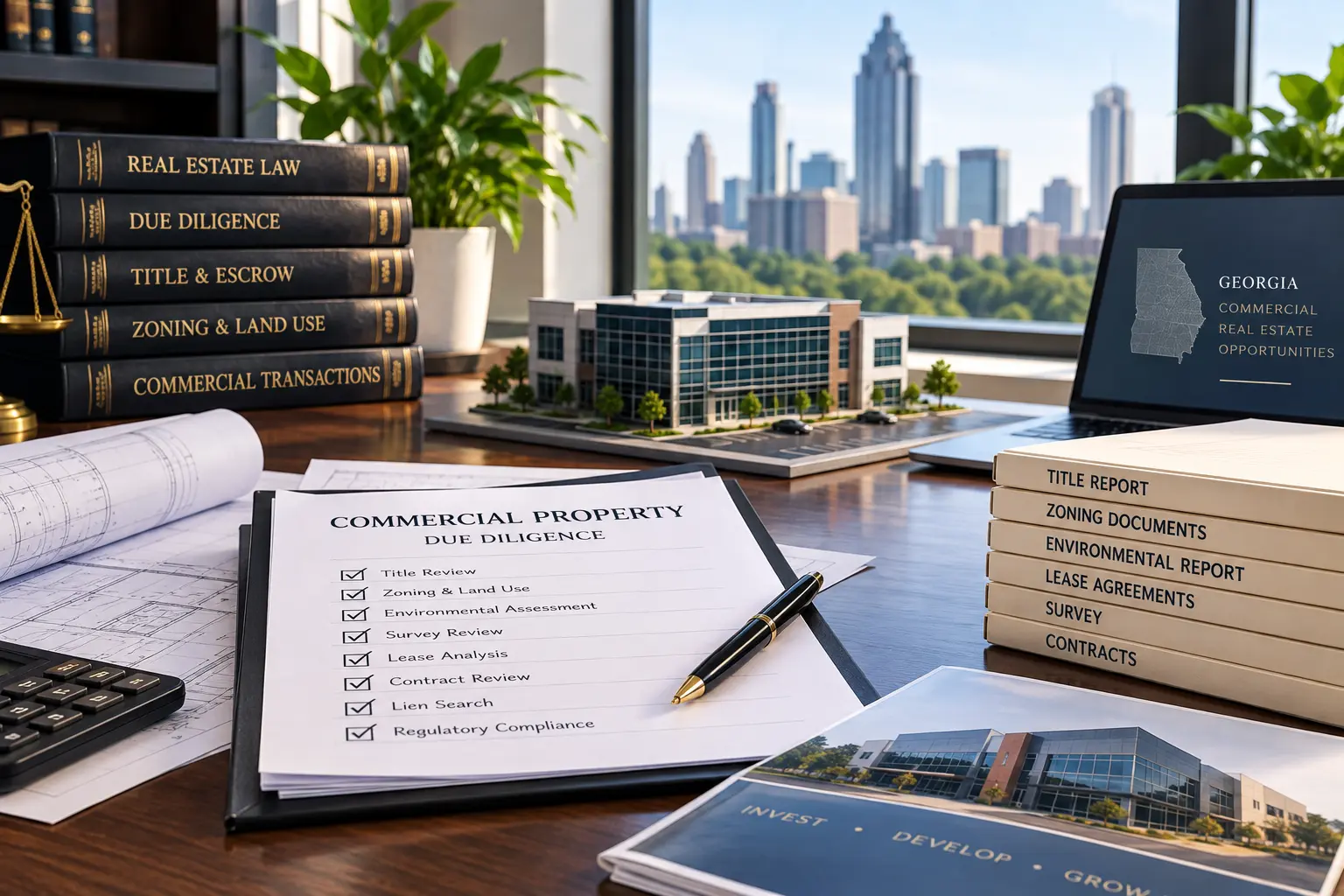
Title and survey review are only part of due diligence. The right scope depends on the property and the buyer’s intended use. For a commercial acquisition, legal review may need to extend into zoning, leases, permits, environmental information, taxes, and entity documents.
- Zoning and permitted-use questions
- Open permits, code violations, or certificate-of-occupancy concerns
- Existing leases, tenant obligations, and estoppel certificates for income-producing property
- HOA or condominium declarations, bylaws, budgets, assessments, and restrictions when applicable
- Property tax status and other governmental claims
- Environmental reports or other specialized due diligence for commercial or industrial property
- Entity formation and authority documents when a company or other legal entity is a party
- Assignments of leases, service contracts, warranties, permits, or other rights that are part of the transaction
Not every transaction needs every item on this list. The purpose of legal due diligence is to match the review to the property’s risks, the contract, the financing, and the client’s intended use.
How Are Closing Documents Prepared and Reviewed?
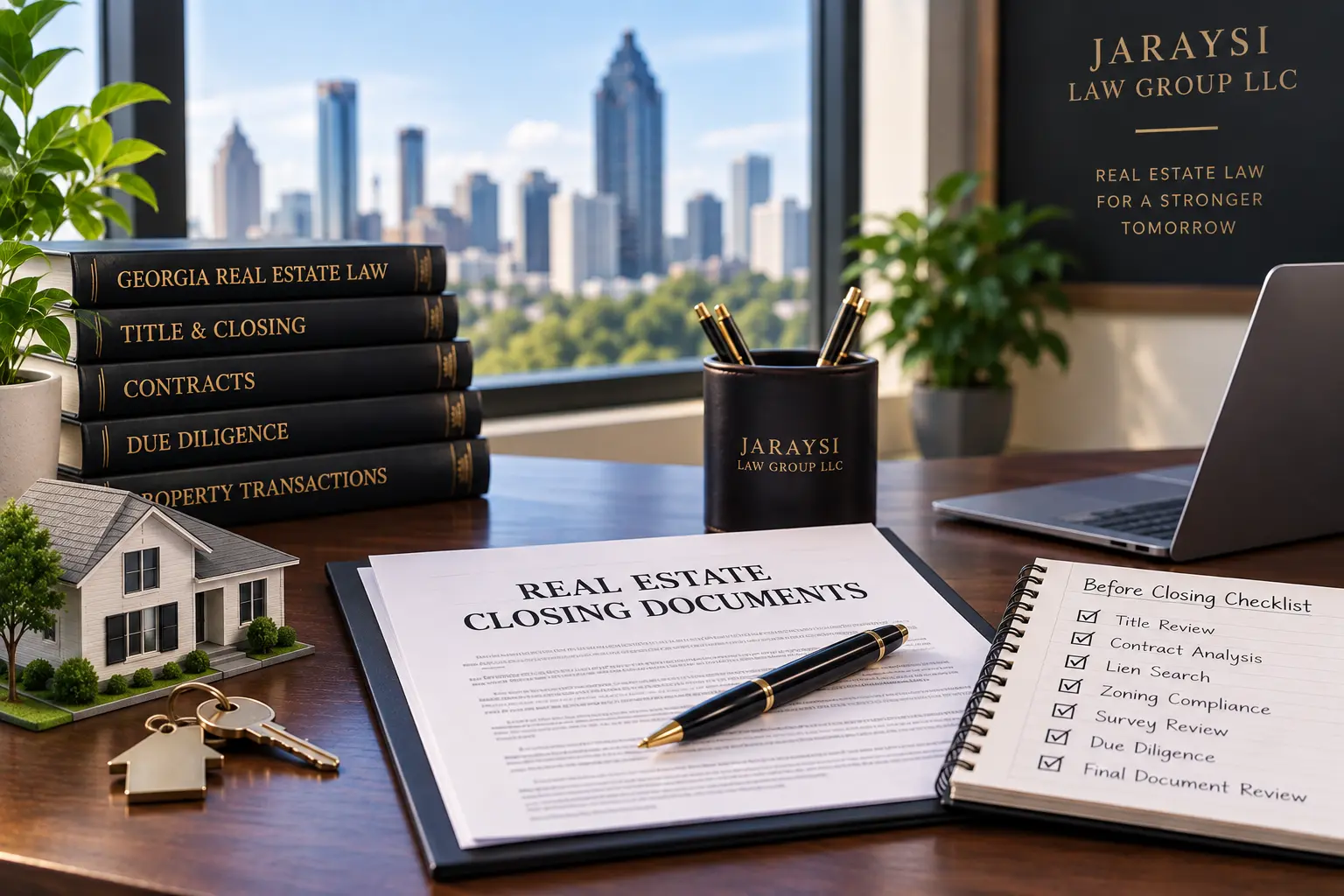
As closing approaches, the attorney coordinates the legal documents with the contract, title work, lender requirements, and final settlement figures. The goal is not simply to produce a stack of documents—it is to make sure the documents tell the same legal story.
Depending on the transaction, the closing package may include:
- A deed transferring the seller’s interest in the property
- Security instruments and other loan documents for financed transactions
- Closing or settlement statements and required disclosures
- Seller and buyer affidavits
- Entity resolutions or authority documents
- Assignments of leases, contracts, or other property-related rights
- Title insurance documents
- Other documents required by the contract, lender, title insurer, or applicable law
The attorney also needs to verify details such as legal names, entity authority, legal descriptions, payoff information, credits, prorations, and other figures. A small mismatch can create a much larger problem when a document is signed, recorded, or relied upon by a lender.
For financed residential transactions, the lender generally must provide the Closing Disclosure within the federal timing framework. That gives the parties an opportunity to review the final numbers before closing, but significant discrepancies should still be addressed as soon as they are identified rather than waiting for the signing appointment.
What Problems Can Delay a Georgia Real Estate Closing?
Many closing delays are not caused by one dramatic legal defect. They happen because several small issues appear at the same time and there is no longer enough time to resolve them before the scheduled closing.
| Problem | What It Can Affect | Possible Response |
| Old lien or judgment | Clear title and seller’s ability to convey | Obtain payoff/release, correct the record, or negotiate another documented solution. |
| Survey discrepancy | Boundaries, access, improvements, financing | Investigate and address through agreement, easement, credit, endorsement, or other remedy. |
| Contract or amendment mismatch | What the parties are actually required to do | Clarify terms and execute a properly documented amendment. |
| Lender condition or funding issue | Ability to close and disburse funds | Work with lender and parties to satisfy conditions or extend the closing. |
| Missing entity authority | Whether the correct party can legally sign | Obtain resolutions, organizational documents, powers of attorney, or other required proof. |
| Undisclosed property issue | Value, use, financing, or contractual rights | Investigate facts and determine whether repair, credit, disclosure, amendment, or termination rights apply. |
The right response depends on the contract and the facts. A closing attorney can help determine whether an issue is curable, whether the parties need additional time, and whether proceeding with the transaction would expose the client to an unacceptable legal risk.
What Happens When a Pre-Closing Problem Cannot Be Fixed?
Not every issue can be resolved before the original closing date. When that happens, the attorney should help the client understand the available choices instead of treating the scheduled closing date as the only objective.
- Extend the closing or a relevant contingency deadline
- Require the seller or another party to complete a specific cure before closing
- Negotiate a credit, escrow arrangement, indemnity, or other risk-allocation provision when appropriate
- Obtain a title endorsement or other documentation that addresses an identified title issue
- Amend the purchase agreement to reflect the parties’ new agreement
- Evaluate termination rights and the treatment of earnest money if the transaction can no longer proceed as agreed
The key question is not simply, “Can we still close?” It is whether the client can close with a clear understanding of the remaining legal and financial risks and whether those risks are consistent with the contract and the client’s goals.
Who Does the Closing Attorney Represent?
This is an important point that buyers and sellers sometimes misunderstand. The attorney conducting a Georgia closing does not necessarily become the personal attorney for every party at the table.
In a financed transaction, the closing attorney commonly represents the lender and must follow the lender’s closing instructions while also handling the legal closing process. A buyer or seller who wants independent legal advice about their own interests may need separate counsel.
That distinction is especially important when the transaction involves unusual contract provisions, significant title questions, disputes between the parties, entity issues, seller financing, development plans, or other risks that require advice tailored to one party.
When Should You Hire a Georgia Real Estate Attorney?
In Georgia, an attorney will be involved in conducting the closing. But waiting until the closing appointment to seek legal advice can be too late to negotiate meaningful changes or investigate a problem properly.
Consider involving real estate counsel early—ideally before or shortly after signing—when:
- You are buying or selling commercial property
- The property is an investment or part of a larger portfolio
- An LLC, corporation, partnership, trust, or other entity is involved
- The transaction includes unusual financing or seller financing
- You have concerns about title, easements, boundaries, access, or restrictions
- The property has tenants or complex lease arrangements
- You are developing, renovating, subdividing, or changing the property’s use
- The contract contains significant contingencies, indemnities, representations, or negotiated risk-allocation provisions
- A dispute has already developed between buyer and seller
- You want legal advice focused specifically on your interests rather than only on getting the transaction closed
Protect Your Interests Before Closing
A real estate closing should be the point where a carefully reviewed transaction is completed—not the first time someone discovers a title problem, missing document, contract conflict, or issue with the property’s intended use.
Jaraysi Law Group LLC advises buyers, sellers, investors, lenders, builders, and other property owners on Georgia real estate transactions, including contract review and negotiation, title issues, due diligence, and closing and transaction support, development matters, and related property concerns.
If you are preparing to buy, sell, finance, or develop property in Georgia, getting legal guidance early can give you more time to identify risks, negotiate solutions, and approach closing with a clear understanding of the transaction. Schedule a consultation with Jaraysi Law Group
FAQs
What does a real estate attorney do before closing in Georgia?
A Georgia real estate attorney can review the contract and amendments, examine title, identify liens and other encumbrances, review surveys and relevant due diligence, coordinate with lenders and other transaction parties, and prepare or review the legal documents needed for closing.
Is a real estate attorney required for closing in Georgia?
Georgia is an attorney-closing state. A Georgia-licensed attorney must control the legal closing process. The attorney’s role includes reviewing the closing documents, addressing title and paperwork issues, and supervising the closing rather than acting only as a notary or witness.
Does the closing attorney represent the buyer or seller in Georgia?
It depends on the transaction. In a financed transaction, the closing attorney commonly represents the lender. That does not necessarily mean the attorney is the buyer’s or seller’s independent personal counsel. A party who needs advice solely about their own interests may want separate representation.
What does a title search look for before closing?
A title examination can identify ownership issues, mortgages, liens, judgments, easements, restrictions, prior conveyances, and other recorded interests that may affect the property or the buyer’s title.
Can a title problem stop a real estate closing?
Yes. A title issue may need to be resolved before closing if it prevents the seller from conveying the expected interest or creates a problem for the lender or title insurer. Depending on the defect, the parties may be able to obtain a release, correction, payoff, endorsement, amendment, or other remedy.
Why is a survey important before closing?
A current survey can reveal boundary issues, encroachments, easements, access concerns, and other physical conditions that may not be apparent from the title record alone. The attorney can compare the survey with the legal description and recorded documents.
What happens if the seller has not completed a required repair before closing?
The answer depends on the purchase agreement. The parties may be able to extend the closing, negotiate a credit, place funds into an agreed arrangement, document a post-closing obligation when appropriate, or exercise another contractual remedy.
Should I hire a real estate attorney before signing the contract?
If you want legal advice about the contract itself, earlier is generally better. A lawyer can identify unfavorable provisions, unclear obligations, unusual risks, and negotiation opportunities before the agreement becomes binding.
What documents should I review before a Georgia real estate closing?
The relevant package varies, but buyers and sellers may encounter the purchase agreement and amendments, deed, settlement statement, loan documents, affidavits, title insurance documents, entity-authority documents, assignments, and other transaction-specific paperwork. Review the documents for consistency with the deal before signing.
Can a Georgia real estate attorney help with commercial closings?
Yes. Commercial transactions often require broader legal due diligence involving leases, zoning, environmental issues, entity authority, financing, development rights, easements, and negotiated contract protections. The scope of review should match the property’s risks and the client’s intended use.
Note: This article is for general informational purposes and is not a substitute for legal advice about a specific transaction.
Disclaimer: This article is provided by Jaraysi Law Group LLC for general informational purposes only and does not constitute legal advice. Reading this content does not create an attorney-client relationship. Laws, fees, regulations, and court decisions referenced may change. For advice on your specific situation, please contact Jaraysi Law Group LLC directly to schedule a consultation.